
Cybersecurity | Chicago Area MSP
Phishing emails used to announce themselves. Broken grammar. A sender address that made no sense. Urgency so cartoonish it almost read as parody. Security training built around those signals worked reasonably well — because the signals were reliable.
They’re not anymore.
AI phishing attacks have shifted the threat model from volume to precision. Cybercriminals are no longer writing messages by hand or recycling templates. They’re deploying AI systems that produce polished, contextually accurate, individually targeted emails at scale. The result is a threat that doesn’t announce itself — one that arrives looking like a message from a trusted colleague, a known vendor, or a senior executive, and reads exactly the way that person would write.
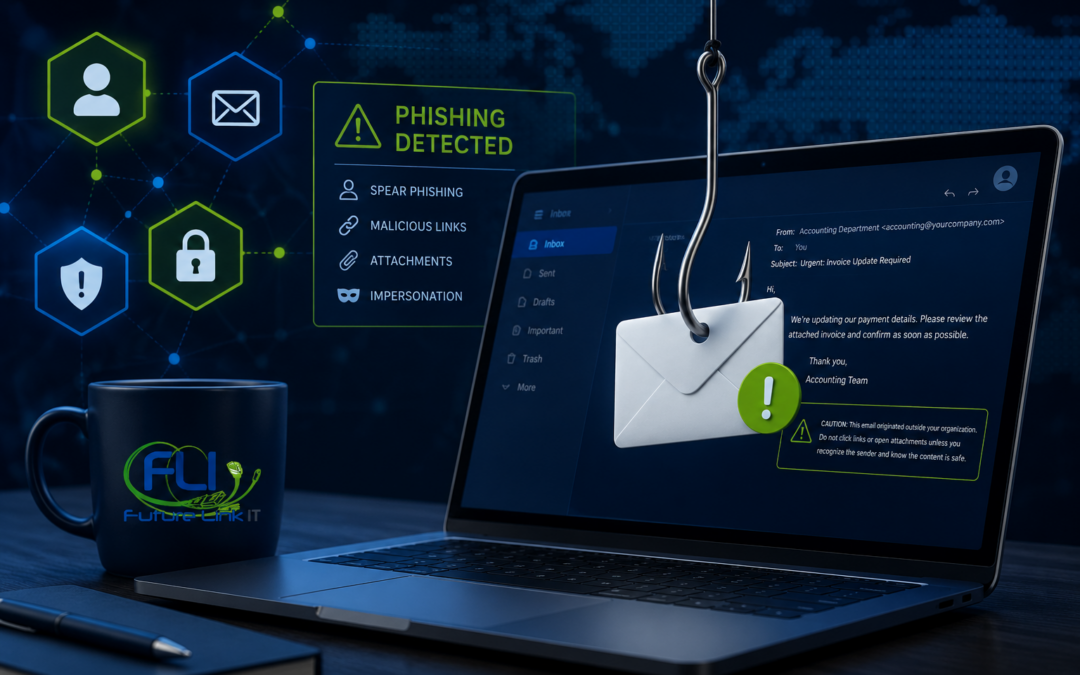
AI phishing uses generative AI to produce highly personalized emails that mimic trusted contacts, replicate internal communication styles, and bypass both technical security filters and human detection. Unlike traditional phishing — which relied on mass distribution of generic messages — AI phishing is targeted, adaptive, and built on real intelligence about the recipient.
- How the Attack Model Has Evolved
- What Does an AI Phishing Attack Actually Cost?
- Why Security Awareness Training Isn’t Enough
- How AI Phishing Bypasses Detection
- The Chicago SMB Threat Landscape
- How Businesses Can Protect Against AI Phishing
- Can AI Be Used as a Cybersecurity Defense?
- Frequently Asked Questions
How the Attack Model Has Evolved
The original phishing model was a numbers game — and generative AI has made that model obsolete. Today’s attacks prioritize credibility over volume, using real intelligence about the target to construct messages that are nearly indistinguishable from legitimate correspondence.
A well-constructed AI phishing email can be generated in seconds, personalized to a specific recipient, and calibrated to the communication norms of the organization being targeted. Attackers harvest data from LinkedIn, company websites, press releases, and social media before a single message is sent. That intelligence feeds directly into the email — producing messages that reference real projects, use real names, and arrive at contextually plausible moments.
IBM X-Force researchers found that generative AI can produce a convincing phishing email in just 5 minutes — a process that previously required 16 hours of skilled human effort. That’s not an incremental improvement. It’s a complete collapse of the attacker’s cost structure.
Source: IBM X-Force, “Generative AI Makes Social Engineering More Dangerous”, IBM.com
The technical infrastructure supporting these attacks has evolved in parallel. Attackers now build fake login portals that replicate Microsoft 365, banking platforms, and HR systems with pixel-level accuracy. Zero-day phishing campaigns frequently pass DMARC, SPF, and DKIM authentication checks because the sending infrastructure is technically clean at the time of delivery.
What Does an AI Phishing Attack Actually Cost a Business?
For U.S. businesses specifically, the picture is starker. The IBM 2025 report found the average U.S. breach cost hit $10.22 million — a record, driven by steeper regulatory penalties and slower detection times. (Bluefin, Oct. 2025)
What those numbers don’t capture is the compounding dynamic of a sophisticated attack. Cybercriminals who gain initial access through phishing rarely act immediately. The more common pattern: extended reconnaissance. Monitor the inbox, map internal relationships and financial authorization workflows, wait for the right moment. By the time the breach surfaces, the attacker may have been present for weeks — and may have used the initial foothold to compromise additional accounts through lateral movement.
Phishing breaches took an average of 254 days to detect and contain in 2025 — nearly nine months. For small and midsize businesses, the financial exposure is not proportionally smaller than it is for enterprises. The data value is often comparable. The recovery capacity is not.
Source: Abnormal AI analysis of IBM Cost of a Data Breach Report 2025
Why Security Awareness Training Isn’t Enough
Traditional security awareness training fails against AI phishing because it teaches employees to recognize static, outdated attack patterns — while AI phishing attacks are dynamic, personalized, and continuously evolving. An annual compliance exercise isn’t a cybersecurity strategy. It’s a documented liability.
Modern attacks use real employee names, copied email signatures, and contextual details sourced from LinkedIn and intercepted communications. These are not clumsy scams — they’re calculated impersonations built on genuine intelligence about the target organization.
82.6% of all phishing emails now contain AI-generated elements. By March 2025, AI-generated phishing campaigns were 24% more effective than those created by elite human red teams.
Source: Whalebone, “AI Impact on Phishing in 2025 & 2026”, citing KnowBe4 2025 Phishing Threat Report and Hoxhunt research
Training programs need to shift to continuous delivery, role-specific content, and live simulations that reflect current attack methodologies. Employees need not just awareness but active support systems — technology that helps them detect what their judgment alone might miss.
How AI Phishing Bypasses Detection
AI phishing defeats conventional detection by eliminating the visual and technical signals that traditional filters and training are designed to catch. When the message looks authentic and the infrastructure is technically clean, human judgment becomes the primary — and often only — line of defense.
Identity spoofing and account compromise
Attackers spoof legitimate sender addresses or compromise real accounts and send messages directly from them. Business email compromise (BEC) attacks frequently exploit this vector, targeting finance and executive personnel with fraudulent payment or wire transfer requests. The FBI’s IC3 2024 report documented $2.77 billion in BEC losses — and an estimated 40% of BEC emails are now AI-generated. (Abnormal AI, 2025)
Style replication through AI modeling
Generative AI systems can be trained on publicly available writing samples to produce messages that closely replicate how a specific person communicates. When attackers have access to actual email archives, the replication can be precise enough to fool colleagues who correspond with the impersonated person regularly.
Contextual personalization via open-source intelligence
Attackers mine professional networks, public calendars, press releases, and news coverage to identify details that make a message feel timely and relevant. This technique — drawing on open-source intelligence (OSINT) — is a defining characteristic of modern spear phishing campaigns.
Infrastructure that passes technical scrutiny
Well-constructed campaigns use clean sending infrastructure with properly formatted DMARC, SPF, and DKIM authentication headers. The message passes through email gateways not because the filters failed — but because it doesn’t exhibit the technical characteristics those filters are designed to detect.
The Chicago SMB Threat Landscape
Businesses across the western Chicago suburbs — Elgin, Schaumburg, Naperville, Aurora, and the surrounding communities — operate in industries that AI-enhanced phishing campaigns actively target. The consequences vary significantly by sector.
Proprietary operational data and supplier relationships create natural social engineering opportunities.
Healthcare breach costs averaged $7.42M in 2025 — the highest of any industry for 14 consecutive years. HIPAA exposure compounds the damage.
Financial services averaged $5.56M per breach in 2025. One compromised account can expose client communications and transaction records.
Public-sector data value combined with limited IT budgets makes municipalities increasingly attractive targets.
Industry cost data: IBM Cost of a Data Breach Report 2025, via DataFence analysis
How Businesses Can Protect Against AI Phishing
Effective protection requires a layered framework combining technical controls, continuous employee training, AI-powered detection, and tested incident response. No single measure is sufficient — all four working together is what makes the difference. The following framework reflects best practices aligned with the NIST Cybersecurity Framework and CIS Controls.
Enable MFA on all email accounts
Multi-factor authentication is the single highest-impact, lowest-cost step most organizations can take. It doesn’t prevent credential theft, but it substantially limits what an attacker can do with stolen credentials — breaking the most common attack chain at a critical point.
Deploy AI-powered email security
Email security platforms that use behavioral AI detect anomalies, identify spoofing patterns, and flag messages that deviate from established communication norms. Organizations using AI security tools extensively averaged $3.62M in breach costs versus $5.52M for those without — a $1.9M difference. Future Link IT’s email security suite includes advanced threat protection, phishing prevention, spam filtering, encrypted email, and MFA. (IBM 2025, via Abnormal AI)
Modernize security awareness training
Replace static annual compliance programs with continuous, adaptive simulations that reflect current attack methodologies. Role-specific training for executives, finance teams, and operations staff is significantly more effective than generic awareness content.
Build a normalized reporting culture
Create an environment where employees feel comfortable reporting suspicious messages, even when uncertain. Make the process frictionless. Recognize employees who surface potential threats. The goal is turning your workforce from a passive target into an active part of the detection system.
Test your incident response before it’s needed
Organizations with a tested IR plan averaged $3.26M in breach costs — 58% lower than the $5.29M average for those without one. Maintain documented procedures, run tabletop exercises, and close identified gaps on a defined timeline. The first 30 minutes after a confirmed compromise are often the most consequential. (Barracuda Networks, citing IBM 2024)
Can AI Be Used as a Cybersecurity Defense?
Yes — and it’s one of the most effective tools available. When deployed in email security platforms and SOC monitoring systems, AI enables behavioral analysis at a scale and speed human analysts can’t match, detecting threats that rule-based filters miss entirely.
AI-powered security tools don’t replace human judgment — they extend it. The IBM 2025 report found that organizations using AI security extensively cut their breach lifecycle by 80 days and saved nearly $1.9 million on average compared to those without. (IBM Cost of a Data Breach Report 2025)
A note on realistic expectations: No defense is absolute. AI-powered email security reduces risk significantly, but determined adversaries will continue to probe for gaps. The attacker needs to succeed once. The defender must succeed every time. That asymmetry is a structural feature of the threat landscape — not a temporary condition. The managed IT model addresses this directly: a managed services provider absorbs the complexity of building and operating a full security stack, delivering enterprise-grade protection through a predictable cost structure.
Frequently Asked Questions
How do AI phishing attacks work?
AI phishing attacks work in three phases: intelligence gathering (harvesting data from LinkedIn, company websites, and social media to profile the target), message generation (using generative AI to produce a personalized email replicating the tone of a trusted contact), and infrastructure deployment (routing the message through technically clean sending infrastructure that passes DMARC, SPF, and DKIM authentication checks). The entire process can be completed in under 10 minutes.
Source: IBM X-Force, “Generative AI Makes Social Engineering More Dangerous”
Is a small business a realistic target for this level of sophisticated attack?
Increasingly, yes. The economics of AI-powered attack generation have lowered the cost of sophisticated targeting to the point where SMBs are viable targets. Small businesses often hold data of comparable value to larger organizations while operating with less robust defenses — a combination that makes them attractive, not less so. The IBM 2025 report found that nearly half of breached organizations (49%) only invested in comprehensive cybersecurity measures after they were breached.
Source: Abacode, “IBM’s 2025 Cost of a Data Breach Report: 7 Key Findings for SMEs”
Is multi-factor authentication enough to stop AI phishing?
MFA is a critical control but not sufficient on its own. It significantly limits what an attacker can do with stolen credentials but doesn’t prevent phishing attempts from occurring. Effective protection requires a layered defense: MFA combined with AI-powered email security, continuous employee training, and tested incident response procedures.
How can I tell if an email is an AI-generated phishing attempt?
AI-generated phishing emails are specifically designed to be indistinguishable from legitimate correspondence. Indicators that warrant scrutiny include unexpected requests for credentials or financial action, messages referencing real internal details arriving from a slightly different domain, and any communication creating urgency around a sensitive transaction. When in doubt, verify through a separate communication channel — call the person directly rather than replying to the email.
Is AI phishing covered by cyber insurance?
Cyber insurance policies vary significantly in their coverage of phishing-related losses. Many policies cover direct financial losses from BEC and credential theft, but coverage limits and exclusions for social engineering attacks differ by carrier. Review your policy language specifically for phishing and BEC coverage. Cyber insurance is a risk transfer mechanism, not a prevention strategy.
What cybersecurity services does Future Link IT offer for phishing protection?
Future Link IT provides a full-stack phishing protection suite including AI-powered email security with advanced threat protection, combined NOC/SOC monitoring, security awareness training with adaptive simulations, network security architecture, and structured cybersecurity assessment engagements. The firm serves SMBs across the western Chicago suburbs from its headquarters in Elgin, Illinois.
Find out where your exposure actually stands
Future Link IT conducts structured Cost and Efficiency Assessments designed to surface vulnerabilities, evaluate your existing controls, and produce a prioritized remediation roadmap. Not an alarm — an honest baseline.
Sources
- IBM Security. Cost of a Data Breach Report 2025. Ponemon Institute / IBM. ibm.com/reports/data-breach
- IBM X-Force. Generative AI Makes Social Engineering More Dangerous — and Harder to Detect. IBM.com, 2025. ibm.com/think/insights/generative-ai-social-engineering
- Bluefin. IBM’s 2025 Cost of a Data Breach Report: Key Findings. Oct. 2025. bluefin.com
- BARR Advisory. Top Takeaways from the 2025 IBM Cost of a Data Breach Report. Aug. 2025. barradvisory.com
- Abnormal AI. IBM Data Breach Report 2025: The Soaring Cost of Email Threats. 2025. abnormal.ai
- KnowBe4 / Whalebone. AI Impact on Phishing in 2025 & 2026. Jan. 2026. whalebone.io
- Abacode. IBM’s 2025 Cost of a Data Breach Report: 7 Key Findings for SMEs. Aug. 2025. abacode.com
- DataFence. Cost of a Data Breach 2025: IBM Report Analysis. datafence.ai